——2026-10-16
The numbers behind aging are well known. The harder question is what actually helps — and where robotics fits in.
By 2030, one in six people worldwide will be 60 or older — up from one in eight in 2017. By 2050, the global population over 60 will double to 2.1 billion. In Japan alone, roughly 30% of the population is already past 60.
At the same time, the people who provide care are getting harder to find: the WHO projects a shortfall of around 10 million health and social care workers between 2023 and 2030.
More people needing support. Fewer hands to provide it. That gap is where the elderly care industry is being rebuilt — and where robotics is moving from a novelty to a necessity.
Most care robotics coverage focuses on monitoring, companionship, or lifting. But there's a simpler and more fundamental need: getting around.
For an older adult, losing the ability to move independently is often the beginning of losing everything else. A walk to the bathroom becomes a fall risk. A trip downstairs becomes impossible. Social contact shrinks to a single room. Mobility isn't a convenience — it's the foundation of dignity and independence.
And when mobility is instrumented, it becomes something else entirely: a continuous source of health data.
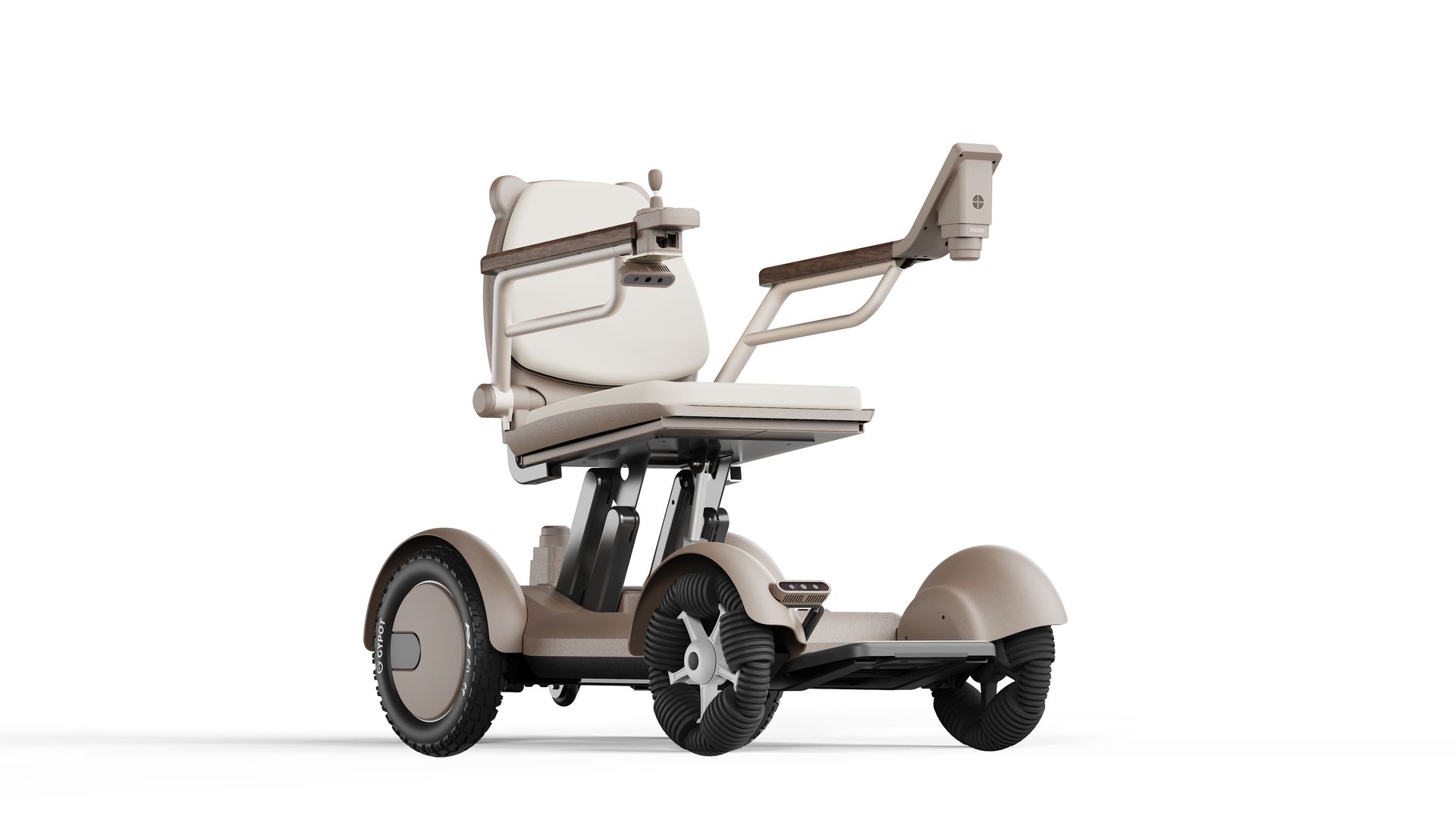
WDC's Cihang PCR is a mobility robot, but that undersells it. It's built on a simple idea — if someone needs help moving, that movement should also keep them safe and observed.
AI-assisted driving (a first for this category) — millimeter-wave radar and dual-vision fusion handle obstacle avoidance while the rider simply steers.
24/7 contactless vital monitoring — heart rate, blood pressure, and blood oxygen, measured without wearables.
AI-assisted TCM consultation — pulse-based assessment and nine body-type profiles, translated into personalized wellness guidance.
Real mobility specs — a 76cm turning radius (elevators, bathrooms), 15cm obstacle clearance, 10° slope capability, 16km range, IP56 water resistance — and it folds for public transport.
A connected care loop — families view location and health status in an app; care institutions manage fleets from a dashboard; hospitals connect through HIS integration for remote consultation.
The robot doesn't replace a caregiver. It removes the repetitive, physical, and constant parts of care — and hands the resulting data back to the people who need it.
Across deployments, the outcomes facilities report are concrete:
|
Setting |
What changes |
|
Home care |
Caregiver burden down ~40%; emergency response success at 100% |
|
Community care centers |
Operating costs down ~40% (positioning accuracy <5cm; one-touch call <15s) |
|
Care institutions |
Nursing efficiency up ~50%; resident satisfaction 92% |
Source: WDC product documentation.
Three things have converged:
The elderly care market is often framed as a demographic problem. It's better understood as an infrastructure problem — and mobility sits at its center.
If you're building care infrastructure — a facility, a home care service, or a distribution portfolio — the question isn't whether robotics belongs in it. It's which part of care you want to make continuous, and measurable, first.
Talk to us about your market. Visit wdcrobot.com or get in touch.

A robot manufacturing brand invested by the Chinese Academy of Sciences. Our own factory supports your customized needs and our vision is to build the most efficient robotics ecosystem in the world.
Terms & ConditionsPrivacy PolicyCopyright © 2024 Jegtheme. All rights reserved.